


WBBA Releases Net5.5G Readiness Assessment Whitepaper for the AI Era
- Details
- Category: Cloud & Virtualisation
- 14702 views
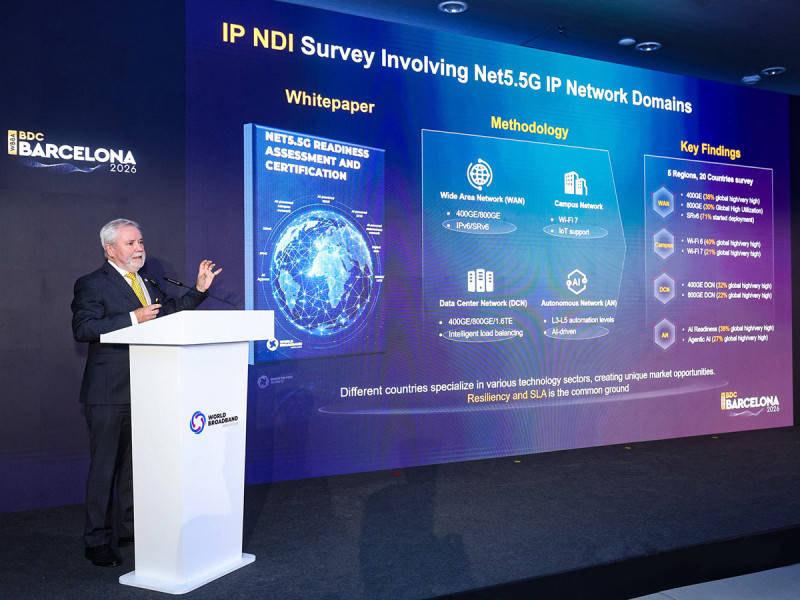
The World Broadband Association (WBBA) brought together leading global operators, enterprises and technology vendors for its Broadband Development Congress (BDC) during MWC26 in Barcelona, and announced the release of the Net5.5G Readiness Assessment and Certification whitepaper. The white paper sets out a standardized framework for intelligent network evolution for operators and enterprises worldwide.
A key element of the whitepaper is the introduction of the IP Network Development Index (IP NDI) developed by the WBBA’s Working Group 4 (WBBA WG4). The IP NDI assesses the readiness of global IP network infrastructure for artificial intelligence (AI) and digital transformation in the 5.5G/6G era, based on a global survey of telco operators' network readiness for AI.
The survey covers six global regions: Africa, Asia and Oceania, Europe, Latin America and the Caribbean, Middle East, and North America, as well as five operator types: Fixed-line operators, Mobile operators, Converged operators (fixed and mobile), ISPs, and Global converged operators (for example, Vodafone, Telefonica, Orange).
The main goal of this comprehensive survey is to establish benchmarks by measuring the maturity of network infrastructure across countries and regions, building on the WBBA’s three earlier publications addressing the evolution of end-to-end data communication networks in the era of 5.5G/6 G and AI: Net5.5G Network Architecture Whitepaper, Net5.5G Best Practices & Deployment Guide, and AI for Net5.5G and Net5.5G for AI Whitepaper.
The surveys and IP NDI insights, which are intended to provide practical guidance for policymakers, operators, and ecosystem stakeholders, cover four domains:
- Wide area networks (WAN) – including deployment of 10Gbps access, 400GE/800GE metro and backbone networks, and IPv6/SRv6 adoption and deterministic networking
- Data centre networks (DCN) – including 400GE/800GE/1.6TE switching fabrics for AI workloads, adoption of RDMA (remote direct memory access) and intelligent load balancing, and support for generative AI and large-scale modelling
- Campus networks – including Wi-Fi 7, high-bandwidth Ethernet, and quality of service, internet of Things (IoT) support and immersive collaboration, and smart manufacturing and enterprise applications
- Autonomous networks (AN) – including L3–L5 automation levels, AI-driven analytics and network digital twins, and predictive maintenance and self-optimization
Despite the main challenges related to data collection and methodology, such as the lack of standardized datasets for Net5.5G technologies and the need to balance technical accuracy with simplicity, the primary goal of the IP NDI is to support the target audiences, including government agencies, regulatory bodies, network operators, and industry participants.
The aim is to provide them with meaningful policy insights and guidance for network investment decisions, strategic planning for AI-era network evolution, and benchmarking in areas such as End-to-end networks (seamless core-to-edge connectivity), Network benchmarking (measurable quality metrics), Sustainability assessment (future-proof, energy-efficient infrastructure), and Innovation support (enabling of digital transformation and AI services).
The survey’s findings reveal significant disparities in technology adoption and investment strategies:
- Clear patterns emerge across regions and operator types - These create distinct market segments with distinct technology needs, investment patterns and go-to-market requirements (for example, Middle East, North America, and Asia fixed-line operators consistently represent the highest-value regions whereas global converged operators consistently outperform across all regions and technologies).
- Regional development levels significantly affect adoption rates across operator types - Progressive technological advancement rather than disruptive replacement, characterizes deployment patterns.
- Investment patterns tend to follow consistent cross segment trends - Developed market operators invest more across the board regardless of their specific type, while within regions, the operator type influences the technology focus. Government-backed operators generally invest more than their market-driven counterparts.
- Different region–operator-type combinations encounter unique main challenges - North American ISPs prioritize latency, European providers emphasize security, Asian mobile operators concentrate on bandwidth, and African operators deal with budget limitations.
- The highest-value opportunities concentrate in specific cross-segments - North American global converged operators / ISPs, European converged operators, and Asian fixed-line / global converged operators represent 60–70 per cent of total market value despite being 25–30 per cent of operators
Key Technical Indicators
Using the regional and country data, the IP NDI survey produced global figures across the four main areas (WAN, Campus Networks, Data Centre and Autonomous Networks) for the deployment of key technical indicators relating to each area:
- WAN: 38% of respondents said their level of preparedness for carrying future AI traffic across the organization’s end-to-end IP transport network was high or very high. 45% considered 400GE and/or 800GE technologies the most important for the network’s AI readiness and the adoption of SRv6 data, and 71% said they had already started deployment of SRv6.
- Campus Networks: regarding the implementation of WiFi6 and WiFi7 technologies, 40% of respondents reported high or very high deployment of Wi-Fi 6, while the figure for WiFi7 was 21%.
- Data Centre: global deployment levels for 400GE ports were ranked high or very high by 32% for and 800GE ports were 22%.
- Autonomous Networks: high or very high adoption of digital-twin solutions was reported by 29% of respondents, and high or very high adoption of Agentic-AI by 27%.
Based on these findings, the WBBA says the IP NDI white paper lays the foundation for ongoing assessment and certification processes that will guide the global telecommunications industry toward the more intelligent, sustainable, and capable network infrastructures essential to future digital economies. It also serves as a key tool for evaluating and enhancing the readiness of global network infrastructure for the AI era.
By providing measurable benchmarks across four core domains, the index helps stakeholders make informed decisions about network investments, policy development, and technology adoption strategies. This comprehensive framework strategically positions the industry to advance toward Net5.5G/6G networks while supporting the rapid growth of AI-driven applications and digital transformation, says WBBA.
Steady Progress
The Net5.5G Pioneer Program has made steady progress under the WBBA’s leadership. The global pioneer matrix now includes thirty-two visionary pioneers, six region pioneers, and forty-four business pioneers, all of whom are establishing benchmark cases worldwide and driving IP networks forward.
Several partners made presentations during the BDC including Orange Group, one of Africa’s largest pan-regional operators, which is currently upgrading its networks into an AI-ready platform, leveraging high bandwidth, intelligent and agile, efficient, trusted and reliable transport and access networks. CTM in Macao (China) which shared how it is building an intelligent bearer network with Net5.5G AI WAN, leveraging AI training and inference-driven perception to identify encrypted video traffic, enable both precision marketing and application-level experience assurance, so helping to reduce customer churn and boost ARPU.
Several partners shared Net5.5G best practice in the whitepaper These practices include the use of key technologies such as 400GE/800GE, SRv6, network slicing, and network digital maps, along with the commercial value they deliver:
China Telecom Shanghai which has built the industry’s first 400GE IP elastic lossless intelligent computing WAN, deploying AI WAN technologies such as SRv6, RDMA lossless WAN transmission, and network digital maps. Turkcell which leverages Net5.5G AI WAN key technologies, including 400GE/800GE, SRv6, and AI-powered energy efficiency, to deliver high-bandwidth, low-latency, and highly reliable connectivity for diverse services. AIS, Thailand which has launched the “Smart Network, Smart City” initiative, and has already deployed 400GE and network digital map, aiming to build a next-generation IP network based on Net5.5G with ultra-broadband, high reliability, and intelligence. MTN, South Africa which has deployed 400GE, Segment Routing over Internet Protocol version 6 (SRv6), and Network Digital Map/In-situ Flow Information Telemetry (iFIT) to enhance the performance of its converged transport network and increase data usage (DoU).
Ongoing Evaluation and Research
The WBBA says it is committed to further evaluate and research Net5.5G, to continue working to expand and drive the upgrade of operators' IP target networks in the intelligent era, and to inject new momentum into the global digital transformation and intelligent network evolution.
More Articles you may be Interested in...








ZTE’s Super-N Platform boosts energy efficiency



M-Pesa Ethiopia expands into tax collection






Achieving operator growth in the AI development era

Papua New Guinea plans SIM card registration

Huawei Maps Out the AI Agentverse at MWC 2026




 // Turnstile not appearing issue