

Internet - a rival to Africa's mobile phone success?
- Details
- Category: Trends & Forecasts
- 12193 views
Having recently reviewed the success of mobile phones in sub-Saharan Africa, Michael Schwartz looks at the benefits to Africa of the Internet...
Having recently reviewed the success of mobile phones in sub-Saharan Africa (Mobile technology + cellphone customer = African success), Michael Schwartz looks at the benefits to Africa of the Internet.Mobile technology is a difficult act to follow

To say that opinions on the potential of the Internet for Africa are varied is to state the obvious. Some commentators believe in a shining future when the Internet is installed throughout the continent, the cabling and power supply involved are always available and on offer is a range of services of which any North American would be proud.
Then there are those who believe in a more restrained future when basic e-economy functions such as e-commerce will be available but the more leisure-oriented functions will be irrelevant for the foreseeable future. Finally, there are those who spare themselves the possibility of disillusion by saying that the Internet is a myth and Africa's infrastructure and economy simply can not afford it.
Optimists include the G8, with its Charter on the Global Information Society. For G8 IT offers the most fantastic opportunities, as it shapes the 21st century. Here is a weapon to battle against world poverty, as it brings education and enlightenment (perhaps with a strong western bias).
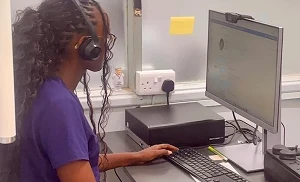
As with any business venture ("you have to speculate to accumulate") a certain level of investment is needed to get onto the Internet in the first place - access to electricity and access to a computer. Some companies may have got to the stage of obtaining a computer but that one computer is as far as it is does get. Known as the "company computer" that sole piece of hardware has to be shared out among all the interested members of staff, assuming the company owner is sympathetic (or is away on business sufficiently often for his/her staff to take advantage of the PC behind his/her back).
This then is a problem which boils down to money:
1) is there enough money for more than one computer?;
2) is there enough money for any computer at all?;
3) is the company owner in favour of staff using the computer(s);
4) can employees use the computer without the boss knowing. Alternatively: What is the Swahili for "you're fired"?
Wealth has its part to play
Surveys of Internet usage in Africa are not, to be honest, very encouraging. One survey of Ethiopia found that 98% of Internet users had a university degree, i.e., the Net is not a means of escaping from one?s social background.. Escaping from poverty can mean so much in Africa. Yet there seems to be a vicious circle. Get to the computer and you may get a degree through private study on a correspondence course. But as we have seen from Ethiopia you will only get to the computer if you have the degree in the first place. Computers and related equipment in their turn cost a substantial amount of money in African terms.
Language too...
And money is not the only factor. Language skills are crucial. Key European languages may be associated with the colonial period. In fact, in this respect one legacy of colonialism may prove to have justified itself. The association of francophone countries, said by some to represent French neo-imperialism, has ensured the promotion of competence in French. At least, some countries are in a good position to exploit the Internet.
There must be some way out
For all this, the problems and challenges remain. There are some countries written off in the West as Third World but which have a standard of living in some cases higher than European countries - stand up Singapore and Taiwan which, fifty years ago, either didn't exist or which were set up from scratch in inhospitable terrain.
Can these countries not share their expertise, proving that it can be done? Or how about successful companies explaining to the business communities in the emerging markets the wonderful opportunities that lie before them? At Developing Telecoms we would be very proud to pay some part, however infinitesimally small that part, in debating and identifying the challenges the emerging markets are facing with regard to the Internet. We are conscious of the digital divide that exists in the world. We have reported on the plans for computers costing less than US$100 and handsets costing less than $US30.
In fact, nothing would give us greater pleasure than to report on citizens in Africa who have their sights fixed on their future qualifications, exploiting internationally recognised course material, obtaining that course material from low-cost computers, and paying the lowest prices possible for their ISP and download charges. Tell us about the problems you face, the problems you have solved, and the opportunities and threats you can see looming ahead in the future.
More Articles you may be Interested in...


Somalia works towards IPv6 transition

NTT Data expands Salesforce offering in Kenya
Nigeria misses target for domain name adoption




IQSTEL plans to acquire 51% of Ghana’s Ultranet


Google to partner Kenyan Tourism ministry